
A Word from the Pastor
Thank you to many who were concerned last week about the broken pipe evidenced by water flowing out of the asphalt on the school playground. It is fixed and thanks to your ongoing generosity, we can pay for it. Unfortunately, we know with any older house, there will be more repairs needed. Please pray they are spaced apart and please continue to support our monthly maintenance and repair fund.
Last weekend, Deacon John gave a fine homily. My friend whom I have referred to a couple of times, Msgr. Arthur Holquin wrote on last week’s readings, and I think as we draw near to election day, his words offer more insight on giving to Cesar what is Cesar’s. He writes:
“St. Paul gives thanks last Sunday for the Thessalonians because, as he says, “our gospel did not come to you in word alone, but also in power and in the Holy Spirit and with much conviction.” Not in word alone.
There is a saying often attributed to St. Francis of Assisi, though it appears nowhere in his writings: Preach the Gospel always, and if necessary, use words. Apocryphal or not, is true. The Gospel is preached most persuasively through the integrity of our lives: in how we keep our promises, how we treat the waiter and the caregiver, how we forgive, how we spend our money and our time, whom we notice and whom we pass by.
And one need not travel to a foreign land to do that. The “mission lands” are no longer only over there. They are here. So, most of us are called to be missionaries right where we are: in our families, our neighborhoods, our workplaces, our communities, and our country.
Which brings us to last Sunday’s Gospel. The Pharisees and the Herodians, strange allies, set a trap for Jesus about the census tax. Jesus asks for the coin, and then asks, “Whose image is this and whose inscription?” Caesar’s, they reply. “Then repay to Caesar what belongs to Caesar and to God what belongs to God.”
This saying has too often been heard as if it divides life into two sealed compartments: religion over here, politics over there, and never the twain shall meet. As if our country could run on moral autopilot while faith stays safely inside the church doors.
But the Fathers of the Church heard it differently. The coin bears the image of Caesar, so give Caesar his coin. But what bears the image of God? We do. “God created mankind in his image.” Every human person is stamped with the divine likeness. And that means every person, and all that concerns the person, belongs to God, including how we organize our common life together.
We have a concrete opportunity to live this out in just over two weeks. On Tuesday, November 3rd, we will cast our votes. That is a civic duty, yes. But for a disciple it is also a moral act, and I would say a missionary one. We are sent to shape the ways of Caesar by the ways of Christ.
I will not tell you for whom to vote. That is not my place, and it is not the Church’s. But I will tell you what the Gospel asks you to bring into that voting booth: a well-formed conscience and a profound respect for the inherent dignity of every human person, from womb to tomb. The child in the womb and the prisoner on death row. The immigrant and the refugee. The poor and the dispossessed. The sick, the elderly, the dying. Cardinal Bernardin called this the seamless garment, and it cannot be torn apart to suit any party’s platform. Our mission is to help shape this nation into a more perfect union, one whose heart beats with that reverence for every person who bears God’s image.
This past week, not far from here in our own state, we saw what that missionary witness looks like. Bishop Joseph Brennan of Fresno wrote to his people about the anxiety and fear that immigration enforcement has brought to the Central Valley. Some of the very people who sit in the pews of his parishes have been detained, taken, as he put it, with little or no information. They are not strangers, he wrote. They are “family, neighbors and parishioners.”
And then he said something every one of us should hear: human dignity “is not granted by governments, economic status, citizenship, or legal documentation. It is given by God.” He quoted Pope Leo, who has reminded us that “human dignity has no passport.”
Bishop Brennan did not stop with words. He described what accompaniment looks like: walking with families through long legal proceedings, showing up at immigration court, arranging rides and childcare, refusing to let anyone face this alone. And he called it what it is: part of our baptismal call. That is Ite, missa est in the flesh. And he did not forget to add the call to pray for one another and to act in a spirit of communion, bridging divisions and treating one another with compassion, even when we disagree.
So here is our mission, yours, and mine. Not, perhaps, the jungles of Peru. But the dinner table where a hard conversation needs a gentle word. The neighbor who is frightened. The coworker who is grieving. The parish that needs our hands. The ballot that needs our conscience.
We are sent. And our mission is nothing less than to be instruments of transformation, so that, as St. Paul says, “Christ is all and in all.”
In a few moments, at the end of this Mass, you will hear the words of dismissal. Hear them today for what they truly are. Not “we’re finished,” but Go. You are sent.”
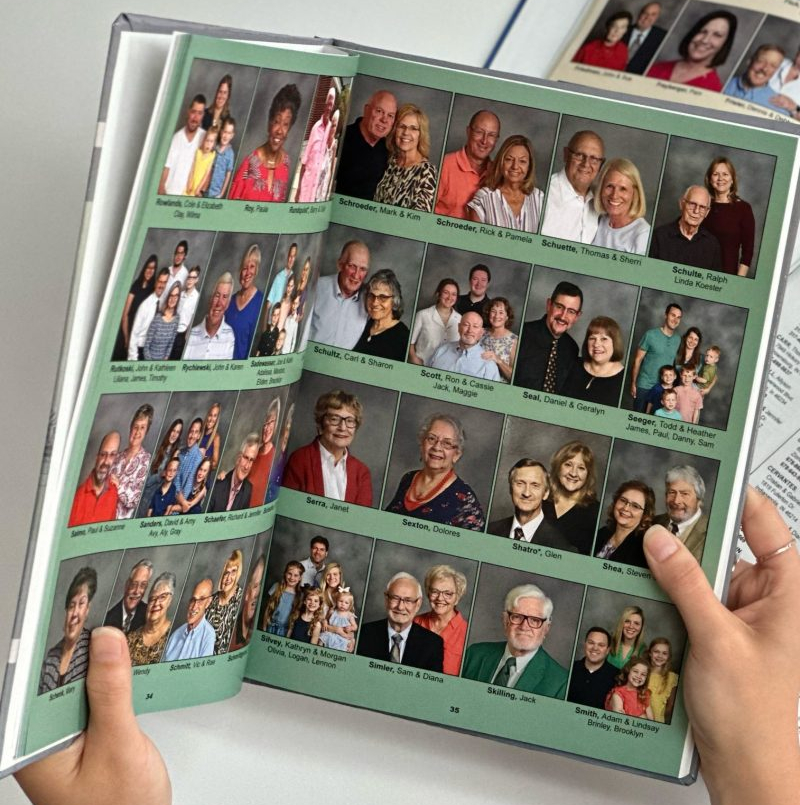
The Parish Photo Directory
has finally arrived!
If you haven't already picked up your Parish Directory, they will be available in the parish office Tuesday - Thursday..
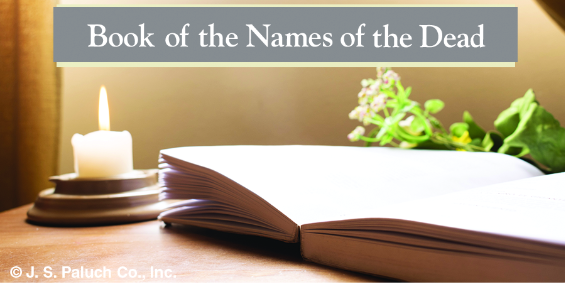
Remember All Souls throughout November The month of November is traditionally reserved in the Church for remembering loved ones who have died. Throughout the month there will be a book in the sanctuary which will include any name you submit or that you write in yourself. You may submit your All Souls envelope with the names of the people you wish to remember now, so we may enter them in the book for the All Souls Mass on November 2. Please feel welcome to write the names of your beloved in this book at any time during the month.
Beginning November 2nd there will also be a table in the sanctuary where you may place free standing framed pictures of your beloved dead. The table will be up for the month of November. Please make sure your name and phone number are on the back of the picture.
Beginning November 2nd there will also be a table in the sanctuary where you may place free standing framed pictures of your beloved dead. The table will be up for the month of November. Please make sure your name and phone number are on the back of the picture.

All are invited to attend the All Souls Day Mass on November 2nd at 7:00 PM (Monday), where we will remember your loved ones who have died.
Please bring photographs of the people you are remembering to place on a table in the sanctuary, prior to Mass.
Please bring photographs of the people you are remembering to place on a table in the sanctuary, prior to Mass.
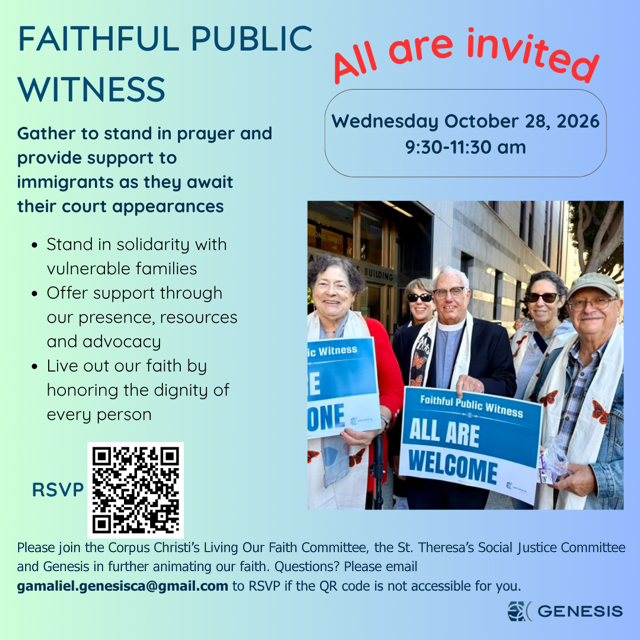
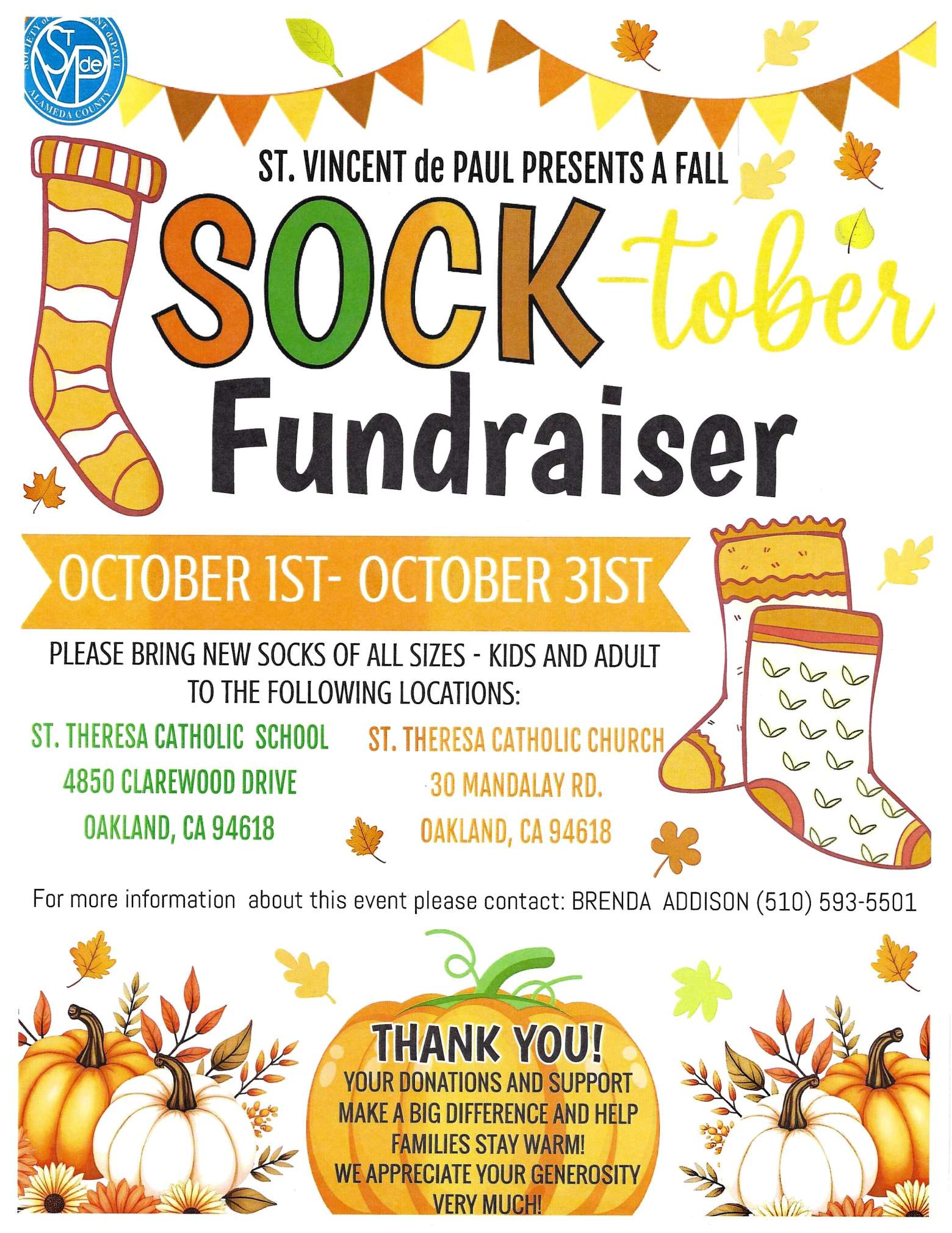
Our St. Vincent de Paul Conference and the school will kick off their annual sock drive, otherwise known as Socktober, to support the St. Vincent de Paul Community Center. Donating to this initiative is easy. Simply buy some socks, any size - kids or adults, and place them in the bin that will be in the vestibule of the church.

Meeting
October 28, 2026
Coletta Lafia, Spiritual Director
Poetry and Spirituality
Friday Flocknote and Bulletin
St. Theresa needs you! Our parish is seeking a dependable, creative volunteer to craft and send our weekly digital and print communications, ensuring our parishioners receive clear, timely, and visually appealing updates. This is a n opportunity, to donate your creative talents to serve the Church, support our ministry efforts, and keep hundreds of families connected, informed, and engaged with parish life.
Key Responsibilities
- Friday Flocknote: Draft, design, and schedule the weekly email newsletter sent out every Friday.
- Sunday Bulletin: Layout and edit Sunday communications and promotional graphics to support parish life and upcoming liturgy details.
- Visual Design: Use templates and custom graphics to present parish news in a clean, inviting format.
- Timely Delivery: Coordinate with parish staff to meet weekly publishing deadlines consistently.
Qualifications
- Software Skills: Proven experience using Canva (or similar graphic design tools) and comfort navigating digital newsletter platforms (Flocknote experience is a plus, but training is available).
- Communication: Strong editing, proofreading, and writing skills with an eye for detail.
- Reliability: Excellent time management to consistently meet tight weekly deadlines.
- Parish Alignment: A heart for service and an understanding of the mission and culture of the Catholic Church.
Send an email to admin@sttheresaoakland.org if you are interested.
Submission Deadlines
Bulletin and Friday Flocknote articles are due Tuesday evening for inclusion in the Friday and weekend publications. The publications are produced and printed on Wednesday. Send to admin@sttheresaoakland.org
St. Vincent de Paul
Fellow Parishioners:
The St. Theresa Conference would like to sincerely thank our parishioners for their generous contributions to our last Fifth Sunday appeal. The need has definitely never been this great and they really stepped up. Our Neighbors in Need salute you!
St. Vincent de Paul, St Theresa Conference
For St. Vincent de Paul Society, preventing homelessness begins with home visits.
https://www.pillarcatholic.com/p/for-st-vincent-de-paul-society-preventing
Our Parish SVdP Conference meets bimonthly, every third Saturday at 9:30am. If interested in learning more about our Conference’s work, contact Judy Bojorquez at jtsbojorquez@yahoo.com with any general questions. Contact Basil Fedynyshyn at st.theresa@svdp-alameda.org if you have a specific question.
You may use online giving to make a donation to the St. Theresa St. Vincent de Paul conference. https://sttheresaoakland.org/donate.

Text to Donate
Text “GIVE” to the number above to receive a link to our online giving page.
You can use our online giving platform to deepen your commitment to the church and the ministries you care about most. Your recurring gifts will sustain our mission month after month. You will also help our parish by cutting costs for envelopes and paper, and allowing our staff to spend less time processing cash and checks and more time on ministries.
Thank you for your continued support of St. Theresa.
You may also use Online Giving for Second Collections.
October 31 & November 1, Parish Maintenance & Improvement Fund
November 14 & 15, Diocesan Campaign for Mercy
November 28 & 29, St. Vincent de Paul

Sunday Collections (October 12 - 18)
Online Giving: 52 Donors $ 2,733.00
Mass Donation: 40 Donors $ 3,137.00
World Mission Sunday
Online Giving: 5 Donors. $ 290,00
Mass Donation: 20 Donors $ 881,00
Reception of the Precious Blood
The reception of the Precious Blood guideline from Bishop Barber, dated May 15, 2023 states: "Other than the priest, no communicant may ever dip the Sacred Host into the chalice to communicate himself."
Assisted Listening available at Weekend Masses
There are two ways to enjoy crisp, clear audio in the church for our weekend Masses.
Option 1:
Download the app, connect to the church wireless network, put in your earbuds, open the app and you are set.
The WiFi password you will need to connect to our wireless network will be available at the sound system desk before and after Mass.
Option 2:
Assisted Listening Devices are available at our weekend Masses. You can check out a device at the sound system desk prior to Mass.
~~~~~~~~
If you have any questions contact Cecile Cuttitta at cecile@sttheresaoakland.org
Volunteering Made Simple
Have you thought about volunteering but worry about fitting it into your schedule? We know life is busy, but here's the good news - serving on Saturdays and Sundays is easier than ever! Out parish used Ministry Schedule Pro, so you can check the schedule online anytime, get reminders, and even request a sub when needed. If you're willing to volunteer, we'd love to have you! Come see me after church today, and I'm happy to help you get connected.
Contact Cecile Cuttitta at cecile@sttheresaoakland.org to volunteer or for more information.
https://sttheresaoakland.org/ministries/liturgical-ministries
Thank you for your faithful support.
Lector
Eucharistic Minister
Sacristan
Altar Server
Greeter
Usher
Projectionist
Video Ministry (9:00 am Mass)
Altar Linens
Weekend Mass Schedule
5:00 pm Saturday
9:00 am Sunday
The 9:00 am Sunday Mass is live-streamed on our YouTube channel for the ill and Homebound.
The link for the live-stream will be on our Facebook page.
https://www.facebook.com/sttheresaoak
YouTube channel link
https://www.youtube.com/channel/UCn5JX1e3QrqXTsa_7qmNCIw
Low Gluten hosts are available at all weekend Masses.
The hosts are less than 20 parts per million gluten, under .002%
For additional information go to https://www.parishcrossroads.com/low-gluten.htm
Please use the presider's communion station to receive a low gluten host.
Weekday Mass Schedule
Monday - Friday
8:30 am
Sacrament of Reconciliation
Saturday ~ 4:00 pm to 4:30 pm
Please remember in your prayers all those who are ill especially:
Matt Mercier, Heidi Parmelee, Dolores Gomez, Alegria Hipolito, Betty Wharton, Juanita Estrella, Olga Lamberti, Roger Baylocq, Susan Springer, Wendy Jones, Orlanda Gonzalez, Kevin Chapman, Diane Cerille, Tom Wilberding, Danny Ramos, Mark Leonard, Christopher Rodriguez, Maryanne Walsh, Rhonda Santeen, John Whatley, Nancy Coyne, Kevin Stallone, Susan Buller, Ann Springer, Ray Bertolotti, William McCarthy, Cindy Crimmins, Fred & Lidia Loupy, Rebecca Rogers, Kathleen Guevara, Clarence Robinson, Armando Diaz de Leon, Bonnie & John Bouey, Marley Malone, Phil Stover, Joey Smith, Raymond Buckley, Jr., Norma Ninalga, Betty Jo Olson, Jennifer Walwark, Greg Govan, Anita Lim, Marilyn McCabe, Steve Lauth, Mary Malloy, John Donovan, Mary Martinez, James Spalding, Tiffany Converse, Adrian McEvilly, Joan Marchi, Diana Nelson Curtis, Charlie Schnellbacher, Maureen Carver, Vince Nims, Barrett Baker, Rick Fama, Eleanor Ceccarelli, Lois Johnson, Antoinette Tamburrino, Anne Marie Roseme, Greg Anderson, Judy Udove, Mary McCole, baby Gianna Sorbello, Yolanda Igano, Betsey Thornton, Karen May, Tom Wallace, John Cocores, Olivia Cors, Aglaia Panos, Keri Nims, Tom Salvatore, Pauline Shear, Larry Ritsch.
Mass Intentions
October 24 - November 1
To request a Mass Intention you can use the online form at
https://sttheresaoakland.org/pray/mass-confession-times/mass-intention
or by email or phone at: admin@sttheresaoakland.org
341.202.0077
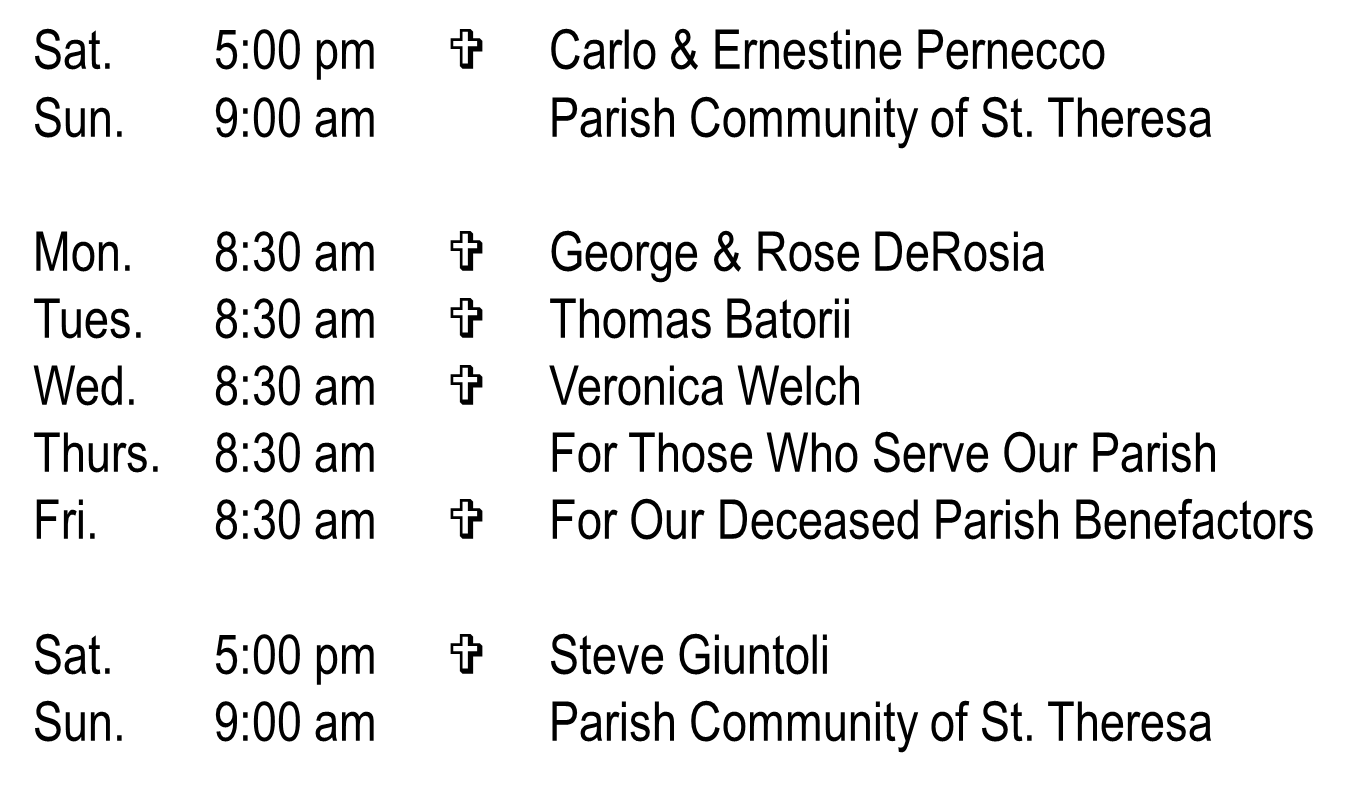
Please remember in your prayers, those who have died especially Jeffrey High.
Schedule a Mass Intention Online
Safe Environment Training for Parish & School Volunteers

It is that time of year when notices of expiring Virtus training will be arriving in your email. Please uuse the link in the email to lob into Virtus and take the training that have been assigned. Training must be renewed every three years.
To renew or register for the first time, click on the link in your email or go to https://www.virtusonline.org or click on the link in the upper right corner of the parish website sttheresaoakland.org.
Please remember that in order to volunteer at the parish or school in any capacity (Lector, Eucharistic Minister, Catechist, Choir Member, St. Vincent de Paul, Legion of Mary, CYO etc.), you must complete the training.
If you have any problems or questions contact Yvonne Gabor at volunteer@sttheresaoakland.org.
Parish Office Hours
Tuesday, Wednesday, Thursday, 10:00 am - 2:00 pm
The parish office is closed Monday, and Friday
Parish Office 341.202.0077
After Hours Medical Emergency:
510.547-2777, Option #4
Parish Office 341.202.0077
Yvonne Gabor volunteer@sttheresaoakland.org
Carla Gaul volunteer@sttheresaoakland.org
Renee Lorda renee@sttheresaoakland.org
Rev. Robert J. McCann, Pastor
341.202.0159
rjmccann@sttheresaoakland.org
Rev. Ngema W. Enow, In Residence
341.202.0137
ngemawil.enow@gmail.com
Cathy Brady, Consultant
341.202.0086
cathy_b@sttheresaoakland.org
Rob Cakebread, Music Ministry Director
341.202.0139
rob@sttheresaoakland.org
Cecile Cuttitta, Liturgy Coordinator
341.202.0077
cecile@sttheresaoakland.org
Martha Gamino, Faith Formation Coordinator
341.202.0076
martha@sttheresaoakland.org
Sophia Kassab, Parish Communications
341.202.0134
sophia@sttheresaoakland.org
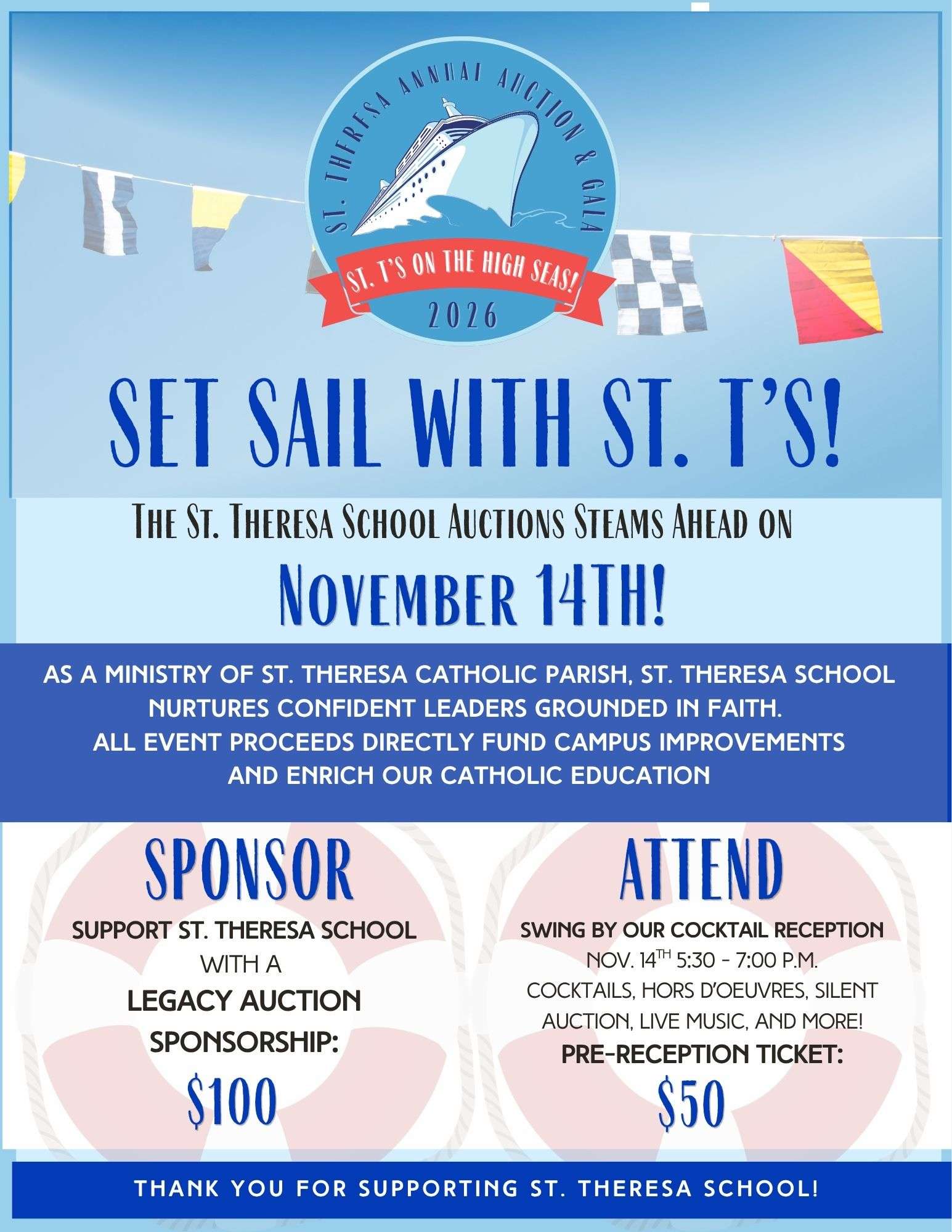
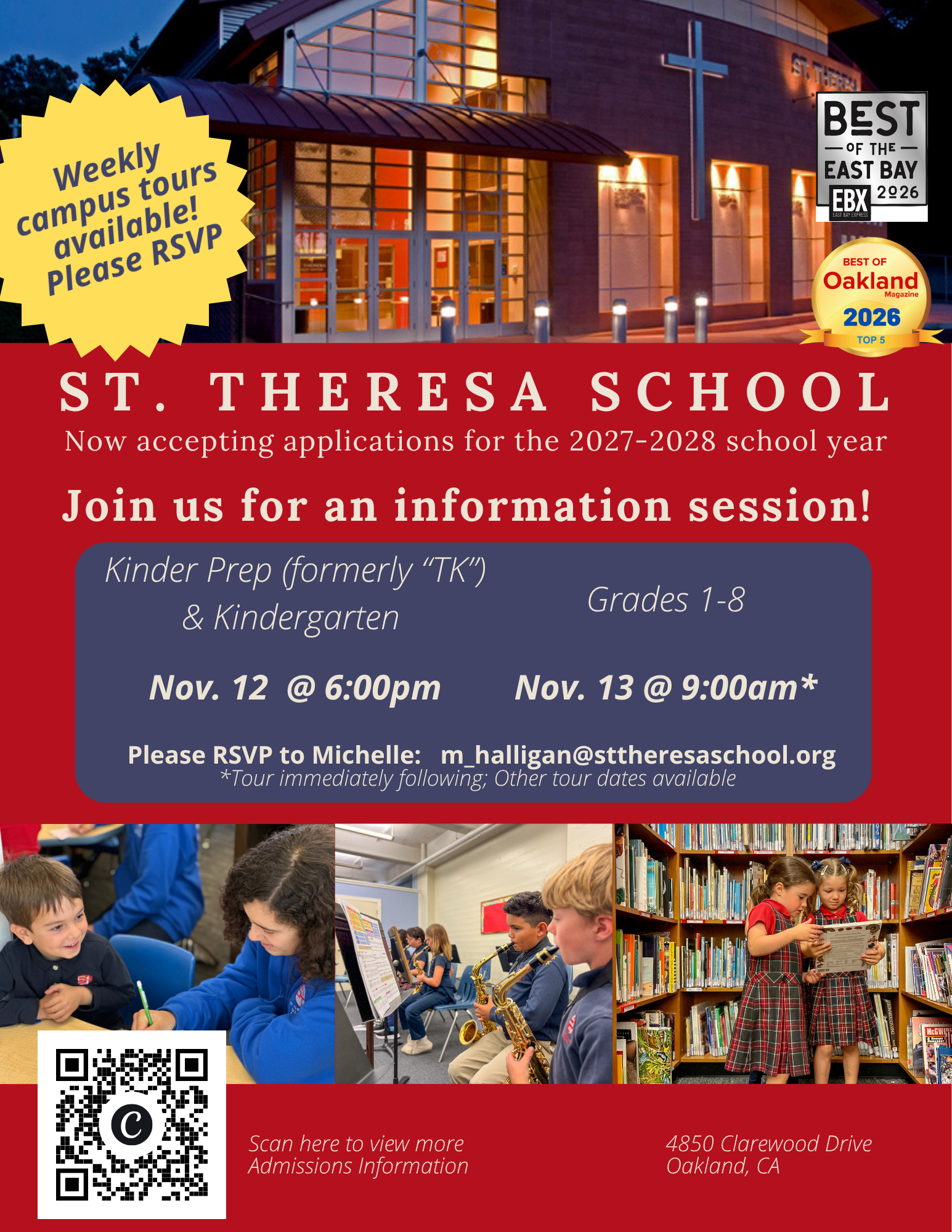
St. Theresa School
Alicia Ortegon, 510.547.3146
St. Theresa School Principal
a_ortegon@sttheresaschool.org
website: www.sttheresaschool.org
Parish Organization Contacts
Pastoral Council:
Chris Colby ccolby@well.com
Finance Council:
Carolyn Mahoney
carolyn.mahoney675@gmail.com .
St. Vincent de Paul Society
Basil Fedynyshyn
st.theresa@svdp-alameda.org
CYO (Catholic Youth Organization):
Carlos Palacios
sttheresaathletics@gmail.com
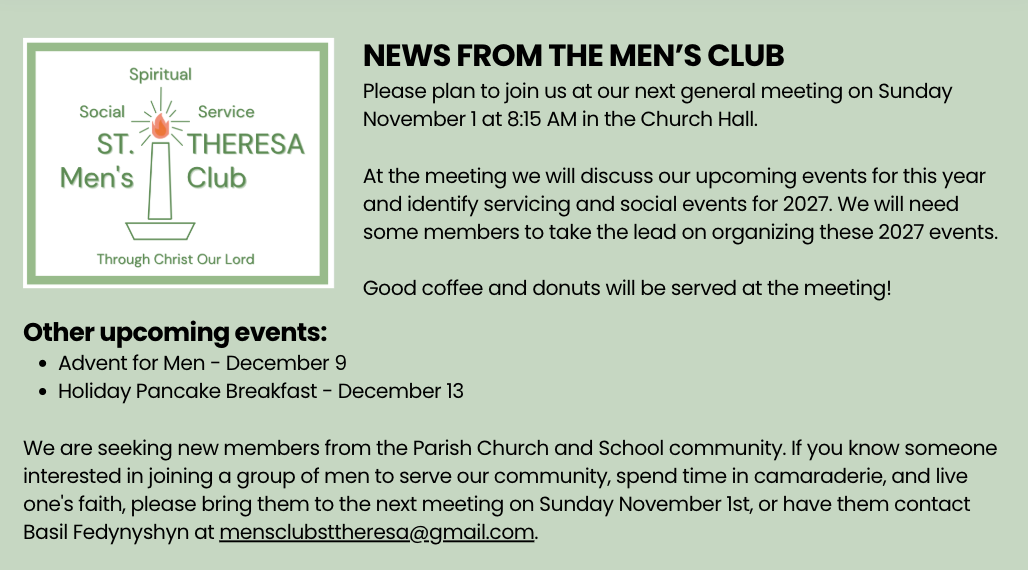
St. Theresa Men’s Club
Basil Fedynyshyn
mensclubsttheresa@gmail.com
Legion of Mary
Tom Wallace
tomw1313@sbcglobal.net
WINGS
Deb McJilton
dolcedeb@yahoo.com
Social Justice Committee (SJC)
Lydia Deck ltdeck@me.com
Consolation Ministry
Cecile Cuttitta cecile.cuttitta@att.net
Men’s Faith Sharing
Jim Frei jim@ottofrei.com
Kinderchurch
Shannon Ciston s.ciston@gmail.com
Baptisms and Marriages: by appointment admin@sttheresaoakland.org
To arrange a Funeral call parish office 341.202.0077 or email admin@sttheresaoakland.org
Family Faith Formation (Grades TK-5) & R.C.I.C: Martha Gamino ~ martha@sttheresaoakland.org
Middle School Youth Ministry (Grades 6-8): Martha Gamino ~ martha@sttheresaoakland.org
High School Youth Ministry/Confirmation: Martha Gamino ~ martha@sttheresaoakland.org
O.C.I.A. Order of Christian Initiation of Adults: Lydia Deck ~ lydia@sttheresaoakland.org
Bishop's Ministry Appeal - 2026

St. Theresa Parish Goal
$35,800
Percentage Achieved 54%
$ 19,230
as of September 30, 2026
Thank you for supporting the Annual Bishop's Ministries Appeal
https://www.oakdiocese.org/bishops-ministries-appeal
Checks must be made out to Roman Catholic Bishop of Oakland.


Please be aware that a scam is going around involving our clergy, and staff (both parish and school) seeking gift card donations.
We will never contact you and ask you to purchase gift cards for us or the parish.
Always stay vigilant and verify all requests from the parish or school office or speak to a staff member.
Protect Yourself:
- Check the email address. The parish address ends in sttheresaoakland.org and the school address ends in sttheresaschool.org
- Always verify
- Trust Your Gut
- Look For Clues
- Skip Unknown Links